2.The operation and feature of the secondary phase-shifted PWM control scheme
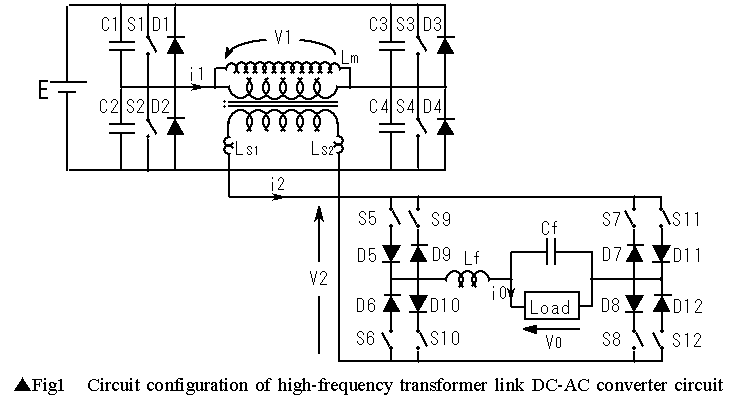
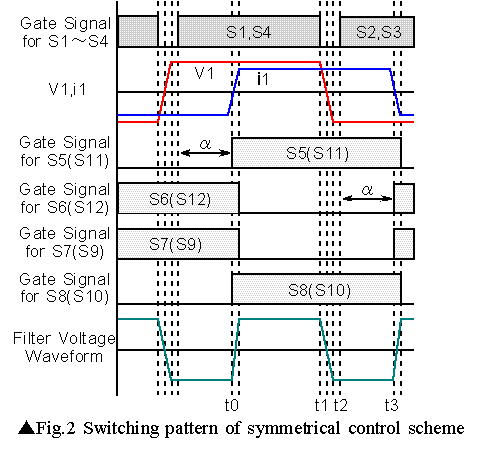
The high-frequency AC link single-phase DC-AC converter is composed of the high-frequency inverter, the high-frequecny transformer and the cycloconverter connected with secondary side. Its feature is to output the commercial power by performing frequency conversion directly using cycloconverter circuit at the secondary side. Since this system does not include conversion into DC power by the diode rectifier circuit after the high-frequency power converted by high-frequency inverter insulates using high-frequency transformer, the power flow can be enabled the both direction processing. In this circuit system, commonly, the output voltage is controlled by symmetrical control scheme. The circuit configuration of the high-frequency AC link single-phase DC-AC converter employing the symmetrical control and that switching pattern are shown in Fig.1 and Fig.2 respectively.
The conventional scheme has some inherent
problems. For instance, the reactive power
will be continued to regenerate in order
to continue the load current io to flow through
on D2,D3,S5,D5,S8,D8 and the high-frequency
transformer after S1,S4 are turned off at
time t1 with ZVS operation. As a result,
the conduction losses of the power devices
and high-frequency transformer are increased
and conversion efficiency is deteriorated.
On the other hand, in the case of the light-load
or no-load, or reactive power secures insufficiently
by condition of power factor, the loss-less
snubber capacitor can not be charged (or
discharged) by lagging current because the
load current own becomes small. As a consequence,
the ZVS operation can not be realized. Hence,
the high-frequency AC link single-phase DC-AC
converter employing symmetrical control scheme
is effective with respect to specific load
such as the fixed load. But if the load has
a wide range from full-load to no-load or
the power factor becomes nearly 1, it is
difficult for this schem to apply to DC-AC
converter. Therefore, the novel proposal
is necessary to be able to keep up with these
requirement. Accordingly, we have proposed
the novel high-frequency AC link DC-AC converter
employing the secondary phase-shifted PWM
control scheme.
The circuit configuration of the high-frequency
AC link single-phase DC-AC converter employing
the secondary phase-shifted PWM control scheme
is similarly to the conventional scheme shown
in Fig.1. The switching pattern at the secondary
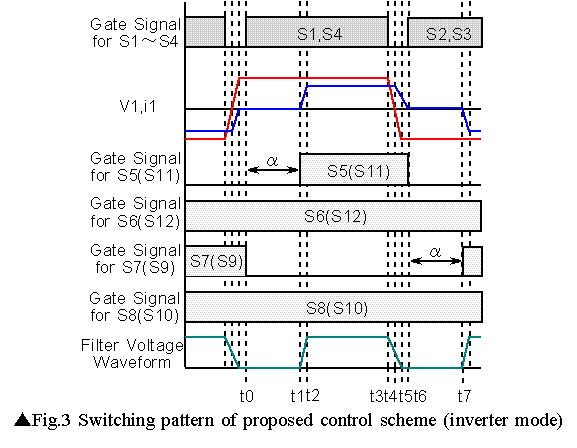
phase-shifted PWM control is shown in Fig.3
.
In the secondary phase-shifted PWM control
scheme, S6 is already turned on before S1,S4
is turned off. As a result, the load current
io is commutated from S5,D5 to S6 D6 because
V1 is a forward bias in D6 and a reverse
bias in D5. In this reason, since the load
current io will start the circulation only
secondary side, there is almost no flow of
i1,i2. This state is the single circulation
interval. At this point, since the reactive
power will not be also regenerated, the charge
and discharge of loss-less snubber capacitor
will be performed as the component of the
reactive power with electromagnetic energy
stored in leakage inductance of high-frequency
transformer. However, the coupling coefficient
of high-frequency transformer used such as
this system is large and it can not be secured
the electromagnetic energy which is enough
to charge and discharge the loss-less snubber
capacitor only a leakage inductance. Therefore,
that deficiency is supplemented by connecting
the auxiliary inductance La,Lb. Moreover,
in the single circulation interval without
supply or regeneration , since the active
power and the reactive power of the load
are processed only secondary side, there
is no current on power devices of high-frequency
inverter and transformer. Hence, the conduction
losses generating on them can be reduced.
For these reasons control scheme becomes
resonant pole type circuit configuration,
the fixed losses become small and the conduction
losses can be reduced comparing with the
symmetrical control scheme. Moreover, this
scheme have many merits which it can be performed
the ZVS stated above, though the secondary
phase-shifted PWM operation with reliability
to every load of the power factor and may
be effective to apply for high-frequency
AC link single-phase DC-AC converter. The
operating mode of the high-frequency AC link
single-phase DC-AC converter can be classified
into two mode. One is inverter mode which
will supply the power from primary side to
secondary side by the power factor of the
load, the other is rectifier mode which will
regenerate the power from secondary side
to primary side. The operation of inverter
mode becomes similarly to the high-frequency
AC link DC-DC converter in order to correspond
with output voltage and current.[8] So, we
will explain the operation of high-frequency
inverter period in rectifier mode which will
be become inverse polarity between output
voltage and current and will be regenerated
the power from secondary side to primary
side.
 Back Top Next
Michihira lab. TOP